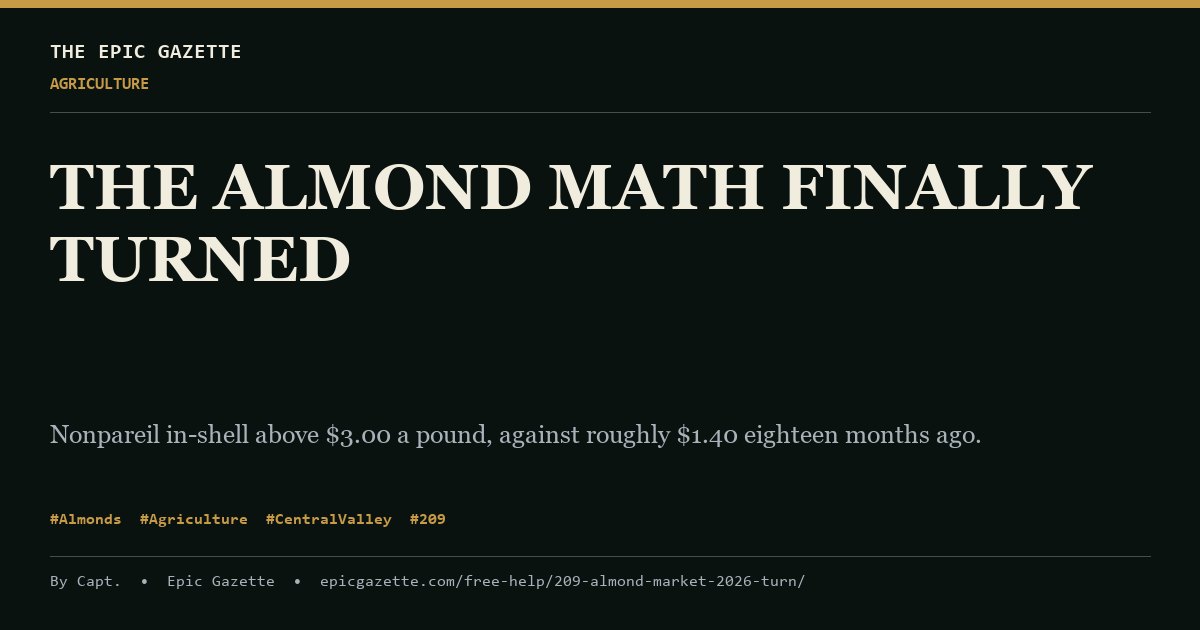
For a couple of very ugly years the arithmetic on an almond acre did not work. Prices sat near the cost of production, carryover stocks were heavy, and growers pulled trees. That has changed, and the change is worth understanding before anybody in the 209 celebrates or panics.
Industry expectations near 2.5 to 2.75 billion pounds, against about 2.7 billion last year.
Some Nonpareil in-shell above $3.00 a pound, up from roughly $1.40 eighteen months ago.
Lower carryover stocks and a strong shipment pace absorbing supply.
Labor, energy, water and compliance costs rose alongside the price.
Supply got smaller and demand kept moving.
Two things fixed the price, and neither of them was a marketing campaign. The crop came in smaller, and shipments stayed strong enough to eat through the inventory that had been sitting on the market and holding prices down. Lower carryover plus a smaller harvest is the textbook setup for firmer prices, and that is what happened.
The removals that made the crop smaller were not evenly spread. The heaviest pulls were in Kern, Fresno and Madera, driven mostly by water availability. In Merced and Stanislaus the removals skewed toward older orchards — this stretch of the valley has a high proportion of aging trees, and a bad price stretch is exactly when a grower finally takes out a block that was on the fence anyway.
The 209 came through comparatively well.
San Joaquin, Stanislaus and Merced posted decent crops this cycle. That matters. In a year where price improves because supply shrank, the growers who benefit most are the ones who still have a crop to sell. Having both is the good outcome, and a meaningful share of this county had both.
Where the money actually goes.
Firmer farm-gate returns have improved cash flow, and cash flow is the thing that keeps an operation alive through a bad stretch. But the break-even price is not what it was. Labor is more expensive. Energy is more expensive. Water is both more expensive and, under groundwater sustainability requirements, less certain. Compliance costs time and paperwork whether or not the crop is good.
The practical read: a grower needs a higher price today than in the last cycle just to hit the same margin. Three dollars now is not three dollars then. That is not pessimism, it is the number you should put in the spreadsheet before deciding whether to replant a pulled block.
What to watch.
Shipment pace through the fall, because that is what tells you whether the demand holding this price is durable or a restock. Water allocations heading into next season. And replant behavior — if a good price year triggers a wave of new plantings, the supply that fixed this market comes back in five to seven years and the cycle runs again.
Watch alongside this story
Footage published by others, shown here with credit. Nothing loads from the video host until you press play.